

Unlock Insights into Workplace Excellence Now
Dive into cutting-edge research on workforce transformation and AI-driven leadership strategies. Join our community to stay informed and advance your understanding of Industrial-Organizational Psychology.
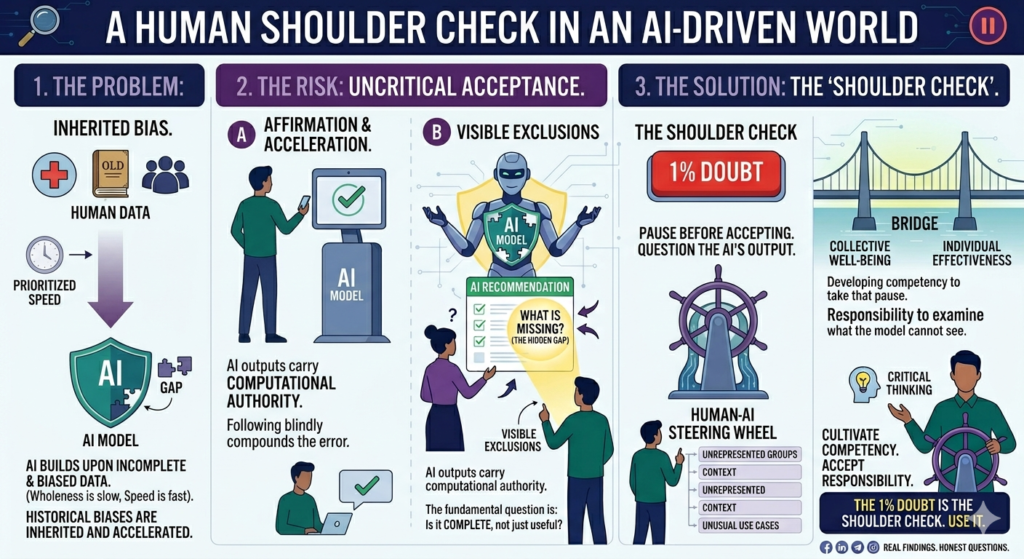
AI Learns From What We Already Know. The Problem Is What We Never Included in the First Place.
In an earlier post, I introduced the idea that in a world driven by algorithmic certainty, the most consequential thing a human being can hold onto is a sliver of deliberate uncertainty, the pause before accepting what the data has already decided for us. That post was a beginning. This is the series that follows.
As I move through my PhD research on AI augmentation, decision-making, and the cognitive and psychological experience of people leaders navigating AI-assisted environments, I will share what I find. Periodically. Honestly. Without the performance of certainty.
Here is where I want to begin.
AI is built on human knowledge. And human knowledge has never been neutral. It is shaped by who conducted the research, who funded it, who was included in the sample, and how urgently the market demanded results. When competition is the primary driver when being first matters more than being thorough the time required to consider diversity, exception, and variation gets compressed. Wholeness is slow. Speed is profitable. And what gets left out rarely announces itself.
This is not a flaw that appeared with AI. It is a pattern AI inherited and then accelerated.
For example, in 1993 the NIH Revitalization Act mandated for the first time that women and minorities be included in federally funded clinical research. Before that mandate, decades of foundational medical knowledge, symptom profiles, drug dosages, and diagnostic criteria had been built almost entirely on male subjects and applied universally. That knowledge did not disappear after 1993. It became the foundation on which subsequent research, clinical tools, and diagnostic frameworks continued to be built. The assumptions embedded in those earlier findings were carried forward quietly, invisibly, and with the full authority of established science. When AI is trained on that accumulated body of knowledge and asked to generate recommendations, it does not start from a clean slate. It starts from a foundation that has never fully accounted for the breadth of human experience.
This pattern is not unique to medicine. It runs through leadership research, organizational decision-making, workforce data, and the frameworks that shape how we develop human potential. In each of these domains, AI is now being asked to learn, recommend, and accelerate, to draw on knowledge bases that were built when many voices were not yet in the room.
The gap does not disappear. It moves faster and becomes harder to question. And this is precisely where the human operator matters.
When we receive an AI recommendation, the question is not only whether it is useful. The deeper question is whether it is complete. Whether the gaps that existed in the knowledge it learned from are now invisible inside the confidence of its output. Whether we are about to follow that recommendation because it is genuinely sound or because it confirms what we already believed and feels efficient to accept.
This is what affirmation bias and sycophancy in AI systems do quietly and consistently. They reflect our existing assumptions back to us with the added authority of computation. And if we do not pause, if we do not perform that shoulder check, we do not just accept the recommendation. We accelerate the gap.
This series is about cultivating the awareness and competency to take that pause. To ask what may be missing. To question not out of resistance to AI, but out of responsibility to the people and decisions that recommendation will touch. Collective well-being and individual effectiveness are not competing outcomes. They become possible together but only when we are willing to examine what the model cannot yet see.
I invite you to follow along. Periodic posts. Real findings. Honest questions.
The 1% doubt is the shoulder check of decision making . Let's use it.
Leaving you with this: Think of the last time you received a data-driven recommendation — from an AI tool, a dashboard, or an automated system. Did you ask whether it was complete, or only whether it was useful? And if you did pause — what did you find in that space?

The Power of 1% Doubt in a Seemingly 99% Certain World
In today’s era of radical augmentation, technology and AI have woven themselves into the fabric of our decision-making processes. From high-stakes executive choices to everyday workflows, we are constantly presented with frameworks that promise near-perfect predictability—99% certainty in efficiency, outcomes, and processes. These systems rely heavily on synthesized data and constructed confidence, offering solutions that appear foolproof. But beneath this veneer of certainty lies a subtle danger: the erosion of our creativity and critical thinking through what is known as affirmation bias—the tendency of AI tools to agree with us, reinforcing existing beliefs and building misplaced trust.
As we increasingly lean on these algorithmic partners, we risk surrendering what philosophers and epistemologists call our epistemic authority—the unique human capacity to interpret and understand reality through lived experiences, intuition, and cultural context. The 99% certainty offered by data-driven models is anchored in what is already known: metrics like turnover rates, absenteeism, engagement scores, and other quantifiable factors. Unfortunately, these numbers often fail to capture the full complexity of human behavior and social dynamics, which is why phenomena like mass “quiet quitting” and cultural erosion continue to emerge despite the most optimized models.
This is precisely where the power of the 1% doubt becomes invaluable.
Unlike traditional risk mitigation strategies that focus on known variables, the 1% doubt acknowledges the unknown—the unpredictable nature of human environments. It is a humble but powerful recognition that no matter how “perfect” or data-driven a plan may seem, it cannot fully account for the intricate realities of human experience and social nuance.
In statistical terms, that 1% is often dismissed as an error margin or noise to be ignored. But in the human realm, that 1% represents autonomy, judgment, and the capacity to push back against a plan that doesn’t quite fit the situation at hand. It is this sliver of uncertainty that preserves our role as authors of our decisions rather than mere users of AI-generated outputs.
Embracing this 1% doubt empowers us to remain the ultimate arbiters of our choices in a world eager to quantify every aspect of our judgment. It encourages us to question, to reflect, and to innovate—ensuring that technology serves as a partner rather than a replacement in the creative and decision-making processes.
So, here’s a question to ponder: When was the last time you experienced that 1% doubt about a perfectly predicted plan or data-driven recommendation? How did listening to that doubt alter the course of your decision or the outcome?
In embracing that tiny but critical space of uncertainty, we safeguard our creativity, our autonomy, and ultimately, our humanity in a world increasingly defined by certainty.